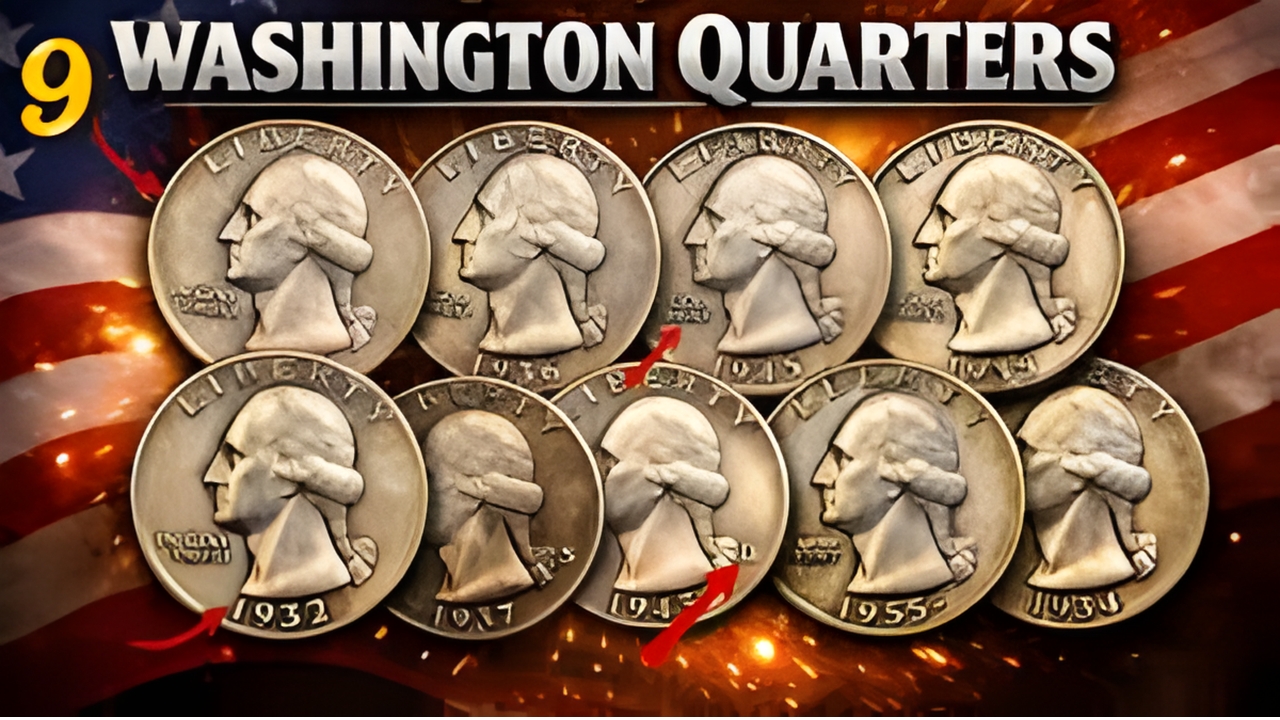
The Washington quarter has been part of everyday American life since 1932. Most people see it as simple pocket change, but collectors know that certain dates and varieties can be worth far more than 25 cents. In fact, a handful of rare Washington quarters have sold for thousands of dollars, with top-condition examples reaching values as high as $50,700. For collectors in 2026, knowing what to look for can turn an ordinary coin into a remarkable discovery.
The beauty of the Washington quarter series lies in its long history. Spanning the Great Depression, World War II, the silver era, and the modern clad period, this coin reflects changing times in both design and composition. While billions have been minted, a few scarce issues stand out as true prizes.
What Is the Washington Quarter and Why Do Rare Ones Matter?
The Washington quarter was introduced in 1932 to celebrate the 200th anniversary of George Washington’s birth. Designed by John Flanagan, the coin features a left-facing portrait of Washington on the obverse and, for decades, a heraldic eagle on the reverse. Because the coin was produced in massive numbers for circulation, rarity usually comes from low mintages, minting mistakes, or transitional changes in metal composition.
Collectors value these coins for several reasons: historical context, scarcity, silver content, and condition. A worn example of a rare date might be worth modestly more than face value, but a high-grade uncirculated specimen can command significant premiums at auction.
The 1932-D and 1932-S Key Dates
The first year of issue produced two of the most famous rarities in the series. The 1932-D and 1932-S quarters were struck in very limited numbers during the depths of the Great Depression. With mintages under half a million each, these coins immediately became key dates.
Finding one in circulation today is unlikely, but collectors actively seek them in all grades. Even well-worn examples can be valuable, while mint-state coins in exceptional condition can bring strong five-figure prices.
1943-D Doubled Die Obverse
Mint errors add excitement to any coin series, and the 1943-D doubled die obverse is a standout. This variety shows noticeable doubling in the date and lettering on the front of the coin. The error occurred during the die creation process, causing design elements to appear slightly duplicated.
Because not many were discovered, this coin remains a prized error variety. Clear, strong doubling increases its desirability and value.
1950-D D Over S Mintmark
The 1950-D quarter features a fascinating mintmark error. In this case, a Denver mintmark was stamped over a previously punched San Francisco mintmark. Under magnification, traces of the underlying “S” can be seen beneath the “D.”
Repunched mintmarks are popular among specialists, and this example tells a unique story of mid-century Mint practices. Collectors often pay a premium for sharply defined examples.
1955 Doubled Die Obverse
Another highly collectible error is the 1955 doubled die obverse. Strong doubling is visible in inscriptions such as “IN GOD WE TRUST.” Compared to minor machine doubling, true doubled dies show consistent and well-defined separation in the letters.
Because of its dramatic appearance, the 1955 doubled die has long been a favorite among error collectors.
1964 Transitional Planchet Error
The year 1964 marked the end of 90 percent silver quarters. Beginning in 1965, the Mint switched to a copper-nickel clad composition. However, a few 1964-dated quarters were accidentally struck on early clad planchets intended for 1965 production.
These transitional errors are extremely rare. Authentication is essential, as weight and edge appearance differ from standard silver coins. Genuine examples are considered major modern rarities.
1970-S Proof-Only Issue
The 1970-S quarter was produced only in proof sets and not released for circulation. As a result, any example found in everyday change would be unusual. High-grade proof coins with deep mirror surfaces and strong contrast between frosted devices and mirrored fields are especially desirable.
1982 No Mintmark Error
In 1982, the Philadelphia Mint began using a “P” mintmark on quarters. However, some coins were struck without the mintmark, creating a collectible error. These missing mintmark coins are subtle but valuable, particularly in uncirculated condition.
1983 Doubled Die Obverse
The 1983 doubled die obverse shows noticeable doubling in Washington’s hair braid and lettering. As a modern variety, it remains affordable compared to earlier rarities but still offers strong collector appeal.
How to Identify Valuable Washington Quarters
Start by checking the date and mintmark. Low-mintage years such as 1932-D and 1932-S should immediately raise interest. Next, examine the coin under magnification for doubling, unusual mintmarks, or off-center strikes.
Silver quarters dated 1964 or earlier weigh 6.25 grams and show a solid silver edge without a copper stripe. Later clad coins display a visible copper core along the edge.
Always handle coins by the edges and avoid cleaning them. Even light cleaning can permanently reduce collector value.
Final Thoughts
Washington quarters may seem ordinary, but within this long-running series lie remarkable rarities. From Depression-era key dates to dramatic doubled dies and transitional errors, these nine quarters highlight the excitement of coin collecting. With careful observation and patience, the next valuable discovery could be hiding in a coin jar, waiting to be noticed.
