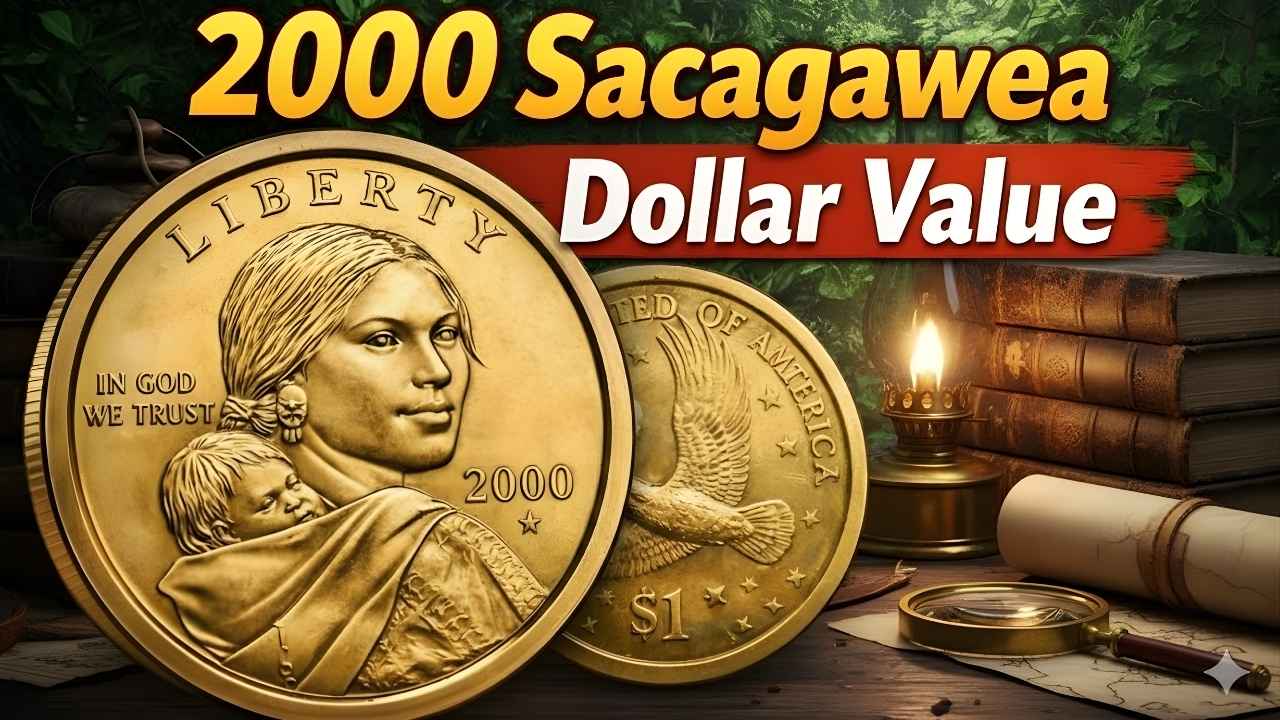
The 2000 Sacagawea dollar remains one of the most talked-about modern American coins, largely because of rumors about extremely valuable versions. Introduced at the start of the new millennium by the United States Mint, the coin honors Sacagawea, the Shoshone woman who assisted the Lewis and Clark expedition. Its golden appearance makes it stand out from other U.S. coins, yet despite its color it is not made of gold. Instead, it consists of a manganese brass outer layer bonded to a copper core. Although millions were produced, certain rare varieties and top-condition examples have become highly collectible.
The Design That Makes It Unique
The obverse shows Sacagawea carrying her infant son Jean Baptiste, a design created to symbolize strength and guidance. On the reverse, a soaring eagle appears surrounded by inscriptions identifying the country and denomination. This elegant artwork, combined with its unusual color, gave the coin instant recognition. Unlike later dollar coins, the 2000 version has a plain edge rather than lettered text, which helps collectors quickly distinguish it from newer issues.
Mint Locations and What They Mean
The 2000 Sacagawea dollar was produced at multiple facilities, each indicated by a mint mark. Coins without a letter came from Philadelphia, those marked with a D were struck in Denver, and coins marked S were proof versions made for collectors. Philadelphia and Denver pieces were minted for circulation in enormous numbers, while proof coins were produced in much smaller quantities and sold in special sets. This difference in production totals is one of the main reasons values vary.
Mintage and Rarity Explained
Mintage numbers strongly influence coin prices. Philadelphia struck more than 700 million examples, and Denver produced over 500 million. By contrast, proof coins from San Francisco were made in far smaller quantities. Because so many standard coins exist, most are common today. However, rarity can still occur if a coin survives in exceptional condition or has an unusual minting feature. Collectors often search for these standout pieces since they are far harder to find.
2000 Sacagawea Dollar Value Table
Type | Condition | Approximate Value
Philadelphia or Denver | Circulated | $1
Philadelphia or Denver | Uncirculated | $2 – $4
Philadelphia or Denver | High Grade | $50 – $200
San Francisco Proof | PR69 | $5 – $15
Cheerios Variety | High Grade | $10,000 – $30,000+
The Famous Cheerios Variety
One of the most valuable versions is known as the Cheerios dollar. In 2000, a promotion placed a limited number of Sacagawea dollars inside cereal boxes. Years later, collectors realized some of these coins had enhanced tail feather details on the eagle design. This subtle difference created a rare variety that can be worth tens of thousands of dollars in top condition. Because the design differences are small, magnification is usually required for identification, and professional authentication is recommended.

The Truth About the 21 Million Dollar Claim
Headlines sometimes suggest a Sacagawea dollar sold for 21 million dollars. There is no verified record of such a sale. The claim likely stems from confusion with special gold pattern coins struck for ceremonial purposes. These prototypes were never released to the public and are not part of normal circulation. Standard Sacagawea dollars, even rare ones, typically sell for far less, though exceptional examples can still reach impressive prices.
Errors That Can Increase Value
Mint errors can dramatically raise a coin’s worth. Some 2000 Sacagawea dollars show double strikes, off-center designs, or planchet flaws. These mistakes occurred during production and slipped into circulation, making them scarce. Depending on how visible and unusual the error is, such coins may sell for anywhere from fifty dollars to several thousand. The key factor is authenticity, since experts must verify that the flaw happened at the mint.
Why Condition Plays Such a Big Role
Condition is one of the strongest drivers of value for modern coins. Many Sacagawea dollars were saved when first released, meaning average examples are easy to find. Only coins preserved carefully without scratches or wear achieve top grades. Professional grading services evaluate coins based on surface quality, luster, and detail. A single grade point difference can dramatically change a coin’s market price.

Tips for Checking Your Coin
If you own a 2000 Sacagawea dollar, start by examining the mint mark and overall appearance. Look closely at the eagle’s tail feathers for unusual detail, check for doubling or misalignment, and weigh the coin if you suspect an error. Avoid cleaning it, since cleaning can reduce collector value. If the coin appears unusual or especially well preserved, professional grading can confirm whether it is rare.
Final Verdict
The 2000 Sacagawea dollar is a fascinating modern coin that combines history, artistry, and collector intrigue. While most examples are worth only one dollar, certain varieties such as the Cheerios type, high-grade specimens, and dramatic errors can be worth substantial sums. The famous multimillion-dollar rumor may be exaggerated, but the coin still offers genuine collecting excitement and the possibility of discovering a truly valuable piece.
