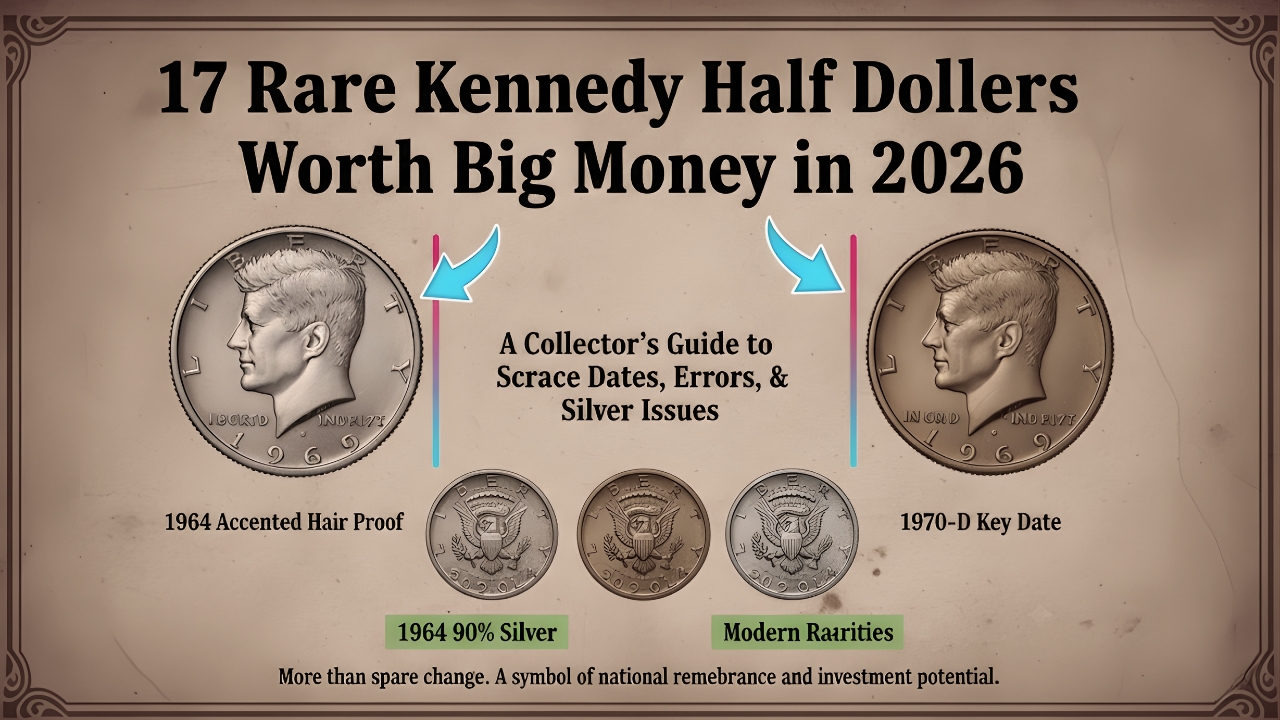
The Kennedy half dollar is more than spare change from another era. Introduced in 1964 shortly after President John F. Kennedy’s assassination, the coin quickly became a symbol of national remembrance. Over the decades, it has evolved from a circulating silver coin into a collector favorite filled with rare dates, design changes, mint errors, and limited releases. For numismatists, the series offers a rewarding mix of history and investment potential.
While millions of Kennedy half dollars have been produced, certain issues stand out for their scarcity and unique characteristics. These 17 rare pieces are especially sought after by collectors who appreciate both their historical meaning and market value.
What Is the Kennedy Half Dollar and Why Is It So Popular?
The Kennedy half dollar was first struck in 1964 as a tribute to the late president. Designed by Gilroy Roberts (obverse) and Frank Gasparro (reverse), the coin features Kennedy’s portrait on the front and the Presidential Seal on the back. The initial 1964 issue was composed of 90 percent silver, which immediately gave it intrinsic value beyond its 50-cent denomination.
Public demand in the first year was overwhelming. Many Americans hoarded the coins as keepsakes, leading to shortages in circulation. From 1965 to 1970, the Mint reduced the silver content to 40 percent before eliminating silver entirely from circulation strikes beginning in 1971. This shift in composition created distinct collectible categories within the series.
The 1964 Silver Issues and Accented Hair Proof
The 1964 Kennedy half dollar remains a cornerstone for collectors. Standard 1964 coins are valued for their silver content, but high-grade uncirculated examples can command strong premiums.
Among the most desirable varieties is the 1964 Accented Hair proof. Early proof dies featured sharper hair details above Kennedy’s ear. The design was later softened, making the accented version a short-lived variety. Collectors carefully inspect proof coins for this subtle difference, and pristine examples can bring impressive prices at auction.
Another mystery surrounds the extremely rare 1964 Special Mint Set coins, believed to have been produced in very limited numbers. These display a distinctive satin finish and are considered major rarities in the series.
Special Mint Sets of 1965–1967
From 1965 through 1967, the U.S. Mint paused traditional proof and mint sets due to coin shortages. Instead, Special Mint Sets were issued with a unique satin-like finish. Kennedy half dollars from these sets are not as rare as the 1964 SMS coins, but they are still highly collectible because of their distinctive appearance and limited production period.
High-grade SMS examples with strong eye appeal often sell for more than standard uncirculated coins from the same years.
The Key-Date 1970-D Half Dollar
The 1970-D Kennedy half dollar is widely considered a key date. Unlike most issues, it was never released for general circulation and was available only in mint sets. Because of its limited mintage, collectors actively seek this coin to complete their collections.
Finding a 1970-D in circulation is unusual, and well-preserved examples consistently command premiums, especially in higher mint state grades.
Valuable Doubled Die and Error Coins
Mint errors have always fascinated collectors, and the Kennedy series includes several notable doubled die varieties. The 1971-D, 1972, and 1974-D doubled die obverses are among the most recognized. On these coins, doubling can be seen in the lettering or date due to die misalignment during production.
The stronger and clearer the doubling, the higher the potential value. As with all error coins, condition plays a major role in determining price.
Off-center strikes and other dramatic minting mistakes also attract attention. While not every error is worth a fortune, unusual and well-preserved examples often sell quickly in the collector market.
Modern Rarities and Anniversary Editions
The Kennedy half dollar series continued to produce collectible highlights well into the modern era. The 1979-S and 1981-S Type 2 proofs feature a clearer “S” mintmark and are scarcer than their Type 1 counterparts.
In 1998, a matte finish proof was issued with a distinctive granular texture, making it stand out from traditional mirror-like proofs. Anniversary editions have also driven demand. In 2014, the Mint released special 50th anniversary coins in .999 silver and even 24-karat gold, instantly creating modern collectibles.
More recently, enhanced reverse proof issues have featured advanced finishing techniques that combine frosted and mirrored surfaces for dramatic visual contrast. These limited releases often sell out quickly and gain value on the secondary market.
Why Collectors Continue to Chase Kennedy Half Dollars
The appeal of the Kennedy half dollar lies in its blend of emotion, artistry, and opportunity. From the 90 percent silver coins of 1964 to scarce varieties like the 1970-D and Accented Hair proof, the series offers something for every level of collector.

For beginners, assembling a silver-date set can be an accessible entry point. For advanced numismatists, hunting down rare varieties and high-grade examples adds excitement and challenge. Each coin represents a moment in American history, making the collection more meaningful than its monetary value alone.
Final Thoughts
The Kennedy half dollar remains one of the most collected modern U.S. coin series for good reason. With 17 standout rarities spanning silver issues, key dates, mint errors, and special editions, the series offers both historical depth and strong collector demand. Whether you are drawn by silver content, rare varieties, or the story behind the coin, Kennedy half dollars continue to hold a respected place in American numismatics and in the hearts of collectors nationwide.
