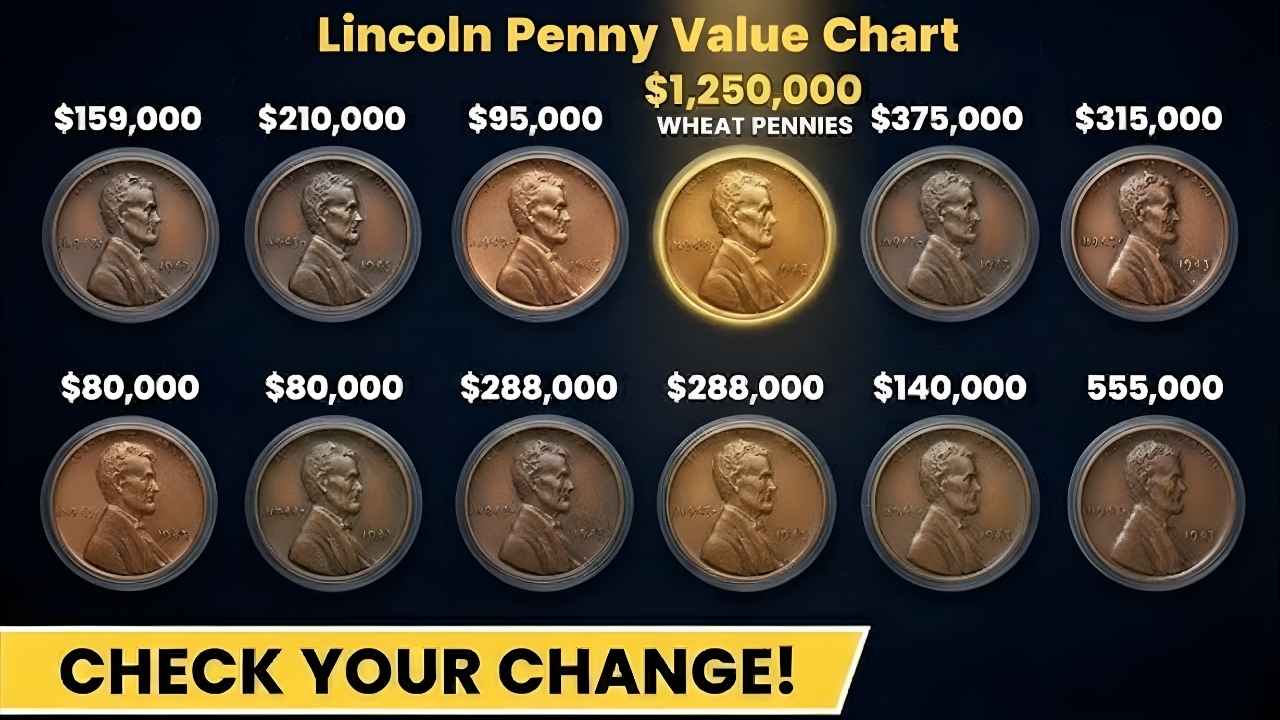
The Lincoln penny has held a special place in American pockets and collections for more than a century. First introduced in 1909 to honor Abraham Lincoln, it became the first U.S. coin to feature a real historical figure rather than symbolic imagery. Produced by the United States Mint, the series has gone through several design changes, metal compositions, and rare varieties. Because of its long history and countless variations, collectors rely on value charts to quickly estimate how much a specific penny might be worth.
Understanding How a Value Chart Works
A Lincoln penny value chart is essentially a pricing guide organized by year, mint mark, and condition. These charts list approximate market ranges so collectors can compare their coins with known values. The condition scale usually ranges from heavily worn coins to pristine uncirculated examples. Even a small difference in grade can dramatically change value. For example, a coin worth one dollar in worn condition could be worth twenty or more if it shows sharp details and original shine. Charts simplify the process by placing all this information into a clear format.
Lincoln Penny Value Chart by Major Types
Different Lincoln penny designs have their own value ranges. Wheat pennies minted from 1909 to 1958 are often more valuable than later versions because of age and lower survival rates. Common dates in circulated condition may be worth three to ten cents, while better dates can reach several dollars. Memorial pennies produced from 1959 to 2008 are usually worth face value unless they are uncirculated or contain errors. Shield pennies, introduced in 2010, are generally modern circulation coins with minimal collector premiums so far. The chart helps collectors see these differences at a glance.
Rare Dates That Stand Out on Value Charts
Certain years consistently appear at the top of value charts because of rarity or historical significance. Early issues from the first decade of production are especially desirable. Low mintage coins, pieces struck at smaller branch mints, and coins with unusual production mistakes tend to command higher prices. When collectors consult charts, they often scan first for these standout dates since they represent the greatest potential finds. Some rare examples can be worth hundreds or even thousands of dollars depending on condition.
The Role of Mint Marks in Determining Value
Mint marks play a crucial role in Lincoln penny values. These small letters indicate where a coin was produced. Coins struck in smaller facilities often had lower production totals, which can make them scarcer today. On value charts, the same year may appear multiple times with different prices depending on mint mark. A Philadelphia coin might be common, while the same year from another mint could be significantly rarer. Learning to identify these tiny letters is one of the first skills collectors develop.
Why Condition Changes Everything
Condition is the single most important factor influencing where a coin falls on a value chart. Collectors use grading terms to describe preservation, ranging from Good to Mint State. Coins that spent years in circulation usually show scratches, fading, and worn edges, lowering their value. Those stored carefully in rolls or albums may still display crisp lines and original color, which increases demand. Value charts always separate prices by grade because a well-preserved coin is far harder to find than a worn one.

Tips for Using a Penny Value Chart Effectively
To use a value chart accurately, start by identifying the coin’s date and mint mark. Next, compare its appearance to grading images or descriptions. It helps to examine the coin under bright light and magnification so small details are visible. Once you estimate its condition, match it with the corresponding value range on the chart. Keep in mind that charts show average market estimates rather than guaranteed prices. Actual selling value can vary depending on demand, eye appeal, and current collector trends.
Final Verdict
A Lincoln penny value chart is one of the most useful tools a collector can have, turning a simple one-cent coin into a window of historical and financial insight. Whether examining a jar of spare change or reviewing a long-held collection, these charts make it easier to identify which pennies are common and which might be hidden treasures. With patience, careful observation, and a reliable guide, even an ordinary-looking penny could reveal unexpected value.